Theodore Roosevelt
As President, Theodore Roosevelt established approximately 230 million acres of public lands between 1901 and 1909, including 150 national forests, the first 55 federal bird reservation and game preserves, 5 national parks, and the first 18 national monuments; an unequaled record!
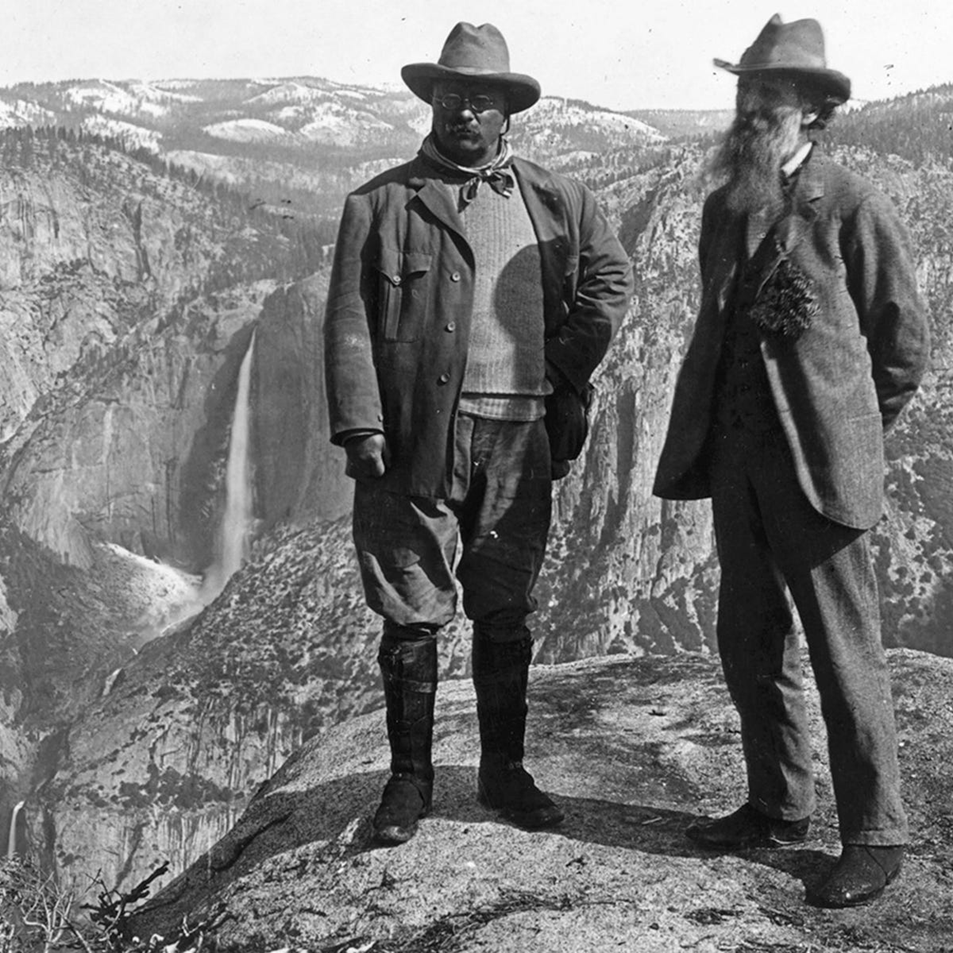
Theodore Roosevelt first visited the area in September 1883, to hunt buffalo, having been convinced by the recollections of a friend that buffalo were plentiful. Although he was successful in obtaining his trophy, it seems likely that he noticed that buffalo now were comparatively few and far between. This may have started him thinking about conservation.
Becoming enamored of this area and the “strenuous life,” he purchased the Maltese cross cattle ranch and, later, the Elk Horn ranch. Below is the Maltese Cross cabin (which has travelled to many places, including the 1904 St Louis World’s Fair). It is now preserved in the Park:

Although appearing fairly modest, it contains three rooms and a large attic storage/living space, so by the standards of the time and place it was quite luxurious.
When touring the national parks, I am often reminded of his quote:
“It is an incalculable added pleasure to any one’s sum of happiness if he or she grows to know, even slightly and imperfectly, how to read and enjoy the wonder-book of nature.”
Geological Background
During the Paleocene Epoch, large amounts of sediments were carried off the eastern slopes of the newly formed Rockies by ancient rivers and deposited here in a series of layers:
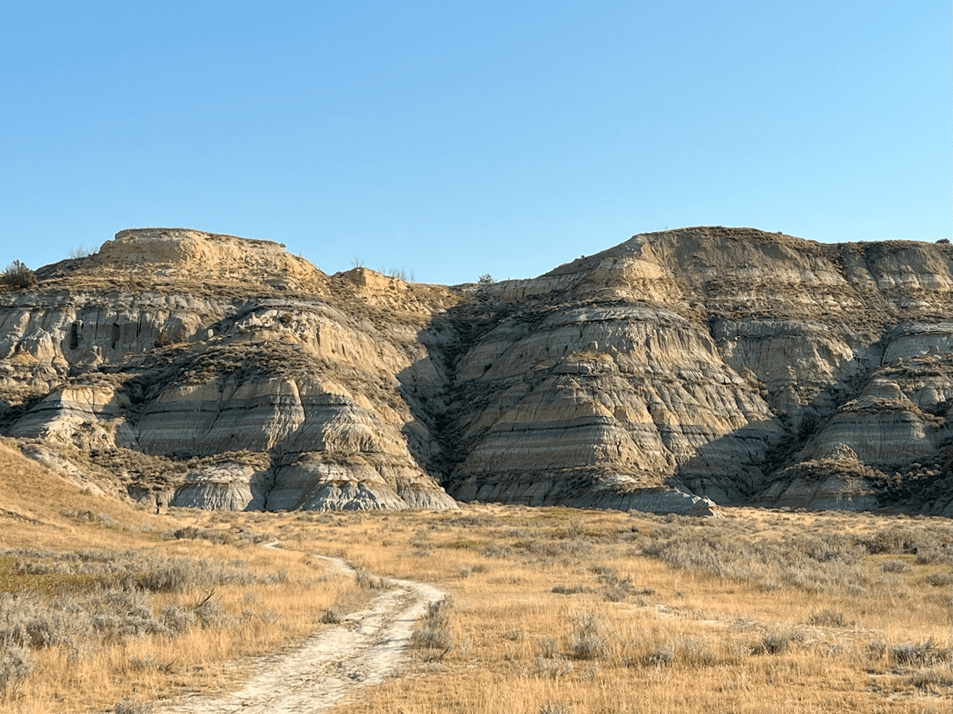
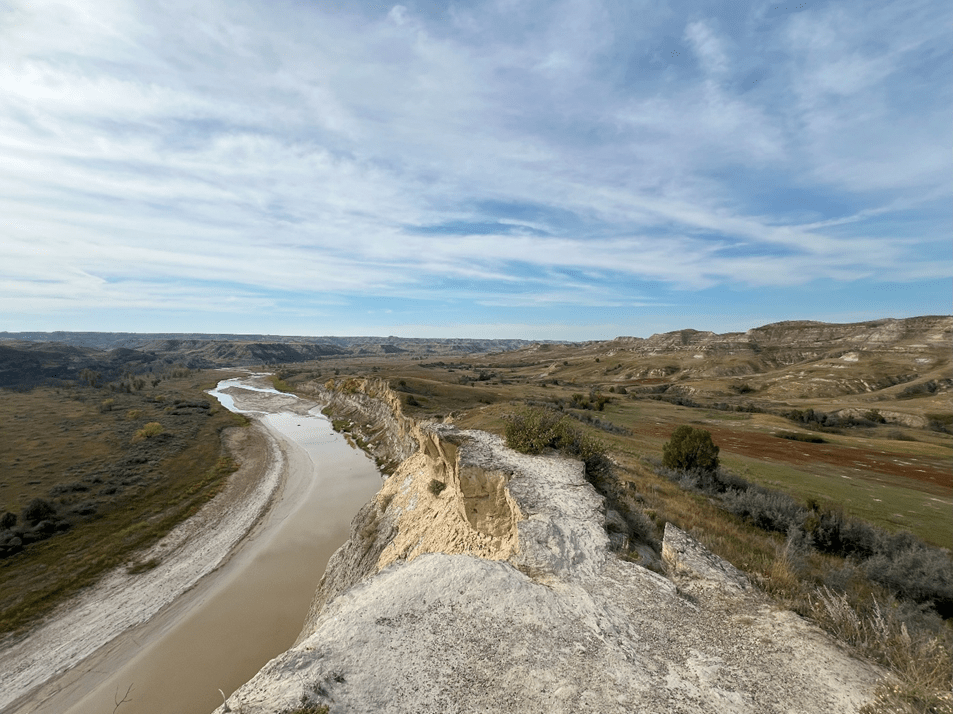
Locally, these layers were eroded and exposed by the Little Missouri River, which runs through all three units of the Park:

Today, this stream runs placidly though the middle of valley it has created, but there are still some areas of active erosion:
Once the layers are revealed, they are further rounded by erosion driven by precipitation of rain, snow and ice yielding the landscape characteristic of the “Badlands,” such as this landscape from the Painted Canyon:

Sometimes a piece of the cliff can break off and be carried a considerable distance forming a “slump” where the layers are at an angle to the horizontal:
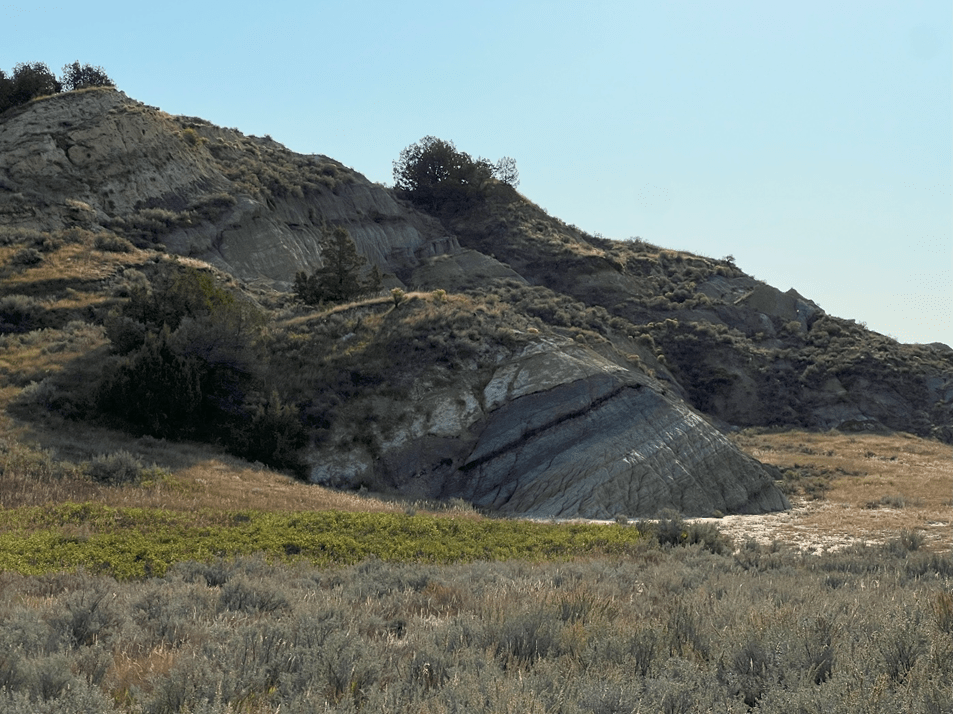
The different layers erode at different rates and the harder layers can form protrusions:

Or “caps” protecting softer layers beneath, forming “hoodoos” and other strange formations:


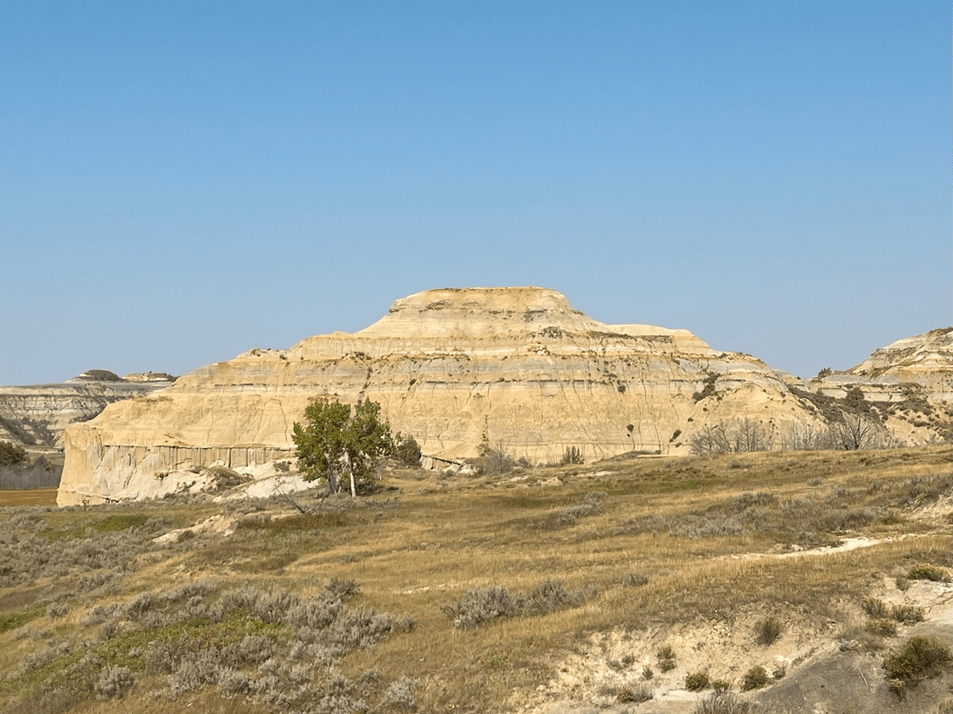
A particularly interesting formation occurs near the “bow” of a structure called the “battleship:”
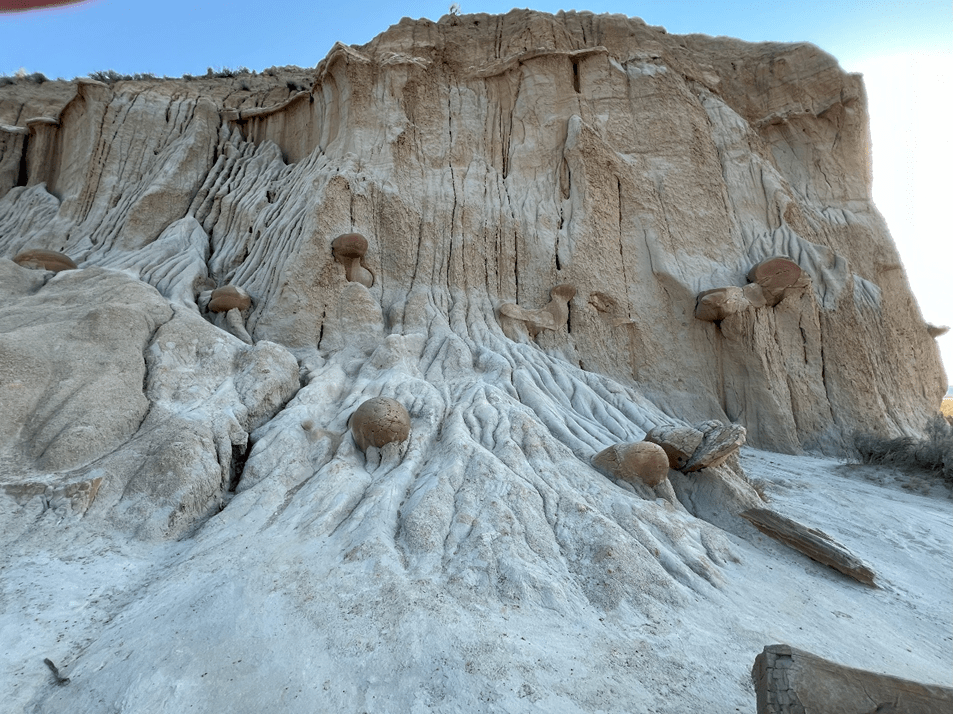
The harder, eroded features resemble “Cannon Balls:”
Here is closeup of a “cannonball:”

The area is permeated with veins of lignite coal which, in the 19th century, was used for heating (wood being too valuable to use for this purpose):

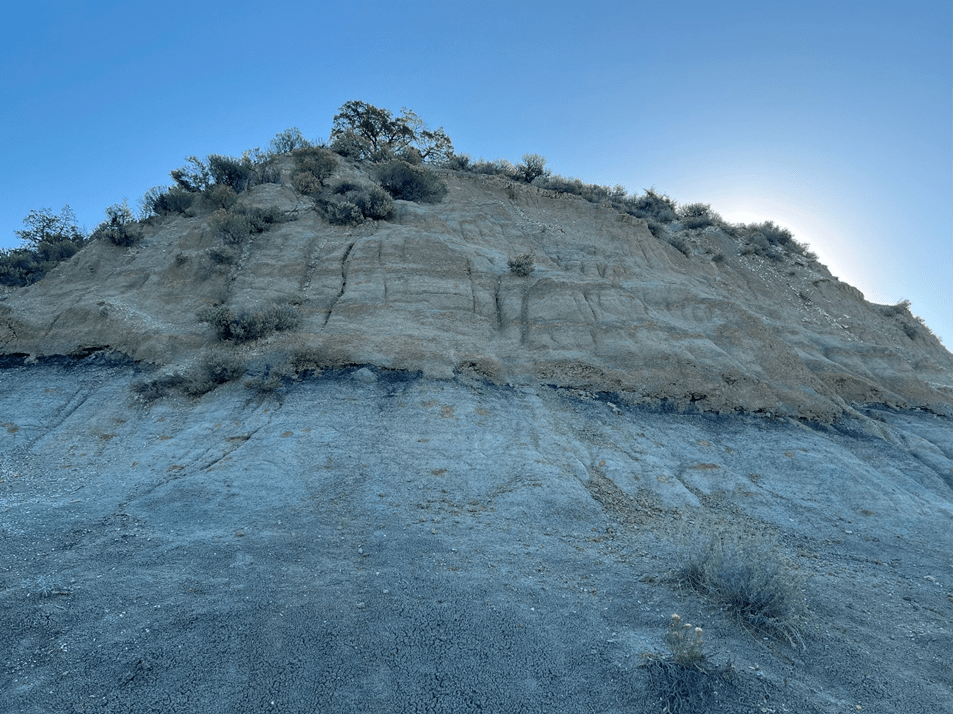
For example, a major lignite fire was ignited by lightning in 1951 and lasted for more than 26 years, causing a major collapse and transforming surrounding layers of rock into hard, baked clinkers;
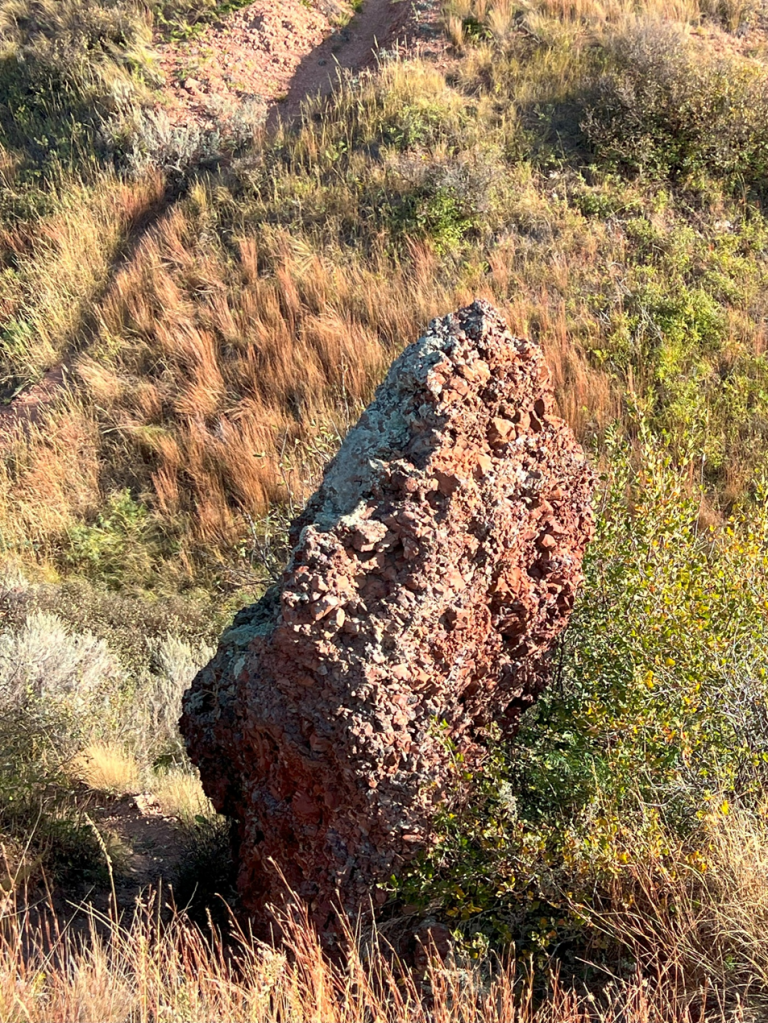
The fire inside the rock was fed by “chimneys’ which supplied the air needed for combustion. The layers around the chimneys were hardened into clinkers. Here is a clinker chimney from that fire, with the surrounding rock long since eroded away.
Scattered throughout the park are deposits of bentonite, an absorbent swelling clay with many industrial uses:


Occasionally, a layer of sedimentary rock contains petrified wood. As this layer is eroded, the petrified wood is revealed and falls to the valley floor:

The geology and dryness of the valley floor is conducive to the development of sinkholes, which can form suddenly and without warning, creating unanticipated hazards. This can be viewed as one of the “bad” features of the “badlands,”

The Park consists of three units. The Northern Unit (near Watford) contains some of the most spectacular scenery while the South Unit seems richer in wildlife (and is the current site of the Maltese cross cabin). The Elk Horn unit encompasses Theodore Roosevelt’s main ranch although it is somewhat difficult to reach.
Wildlife
The iconic wildlife at the Park are bison (“buffalos”) which are easy to find, even at roadside:
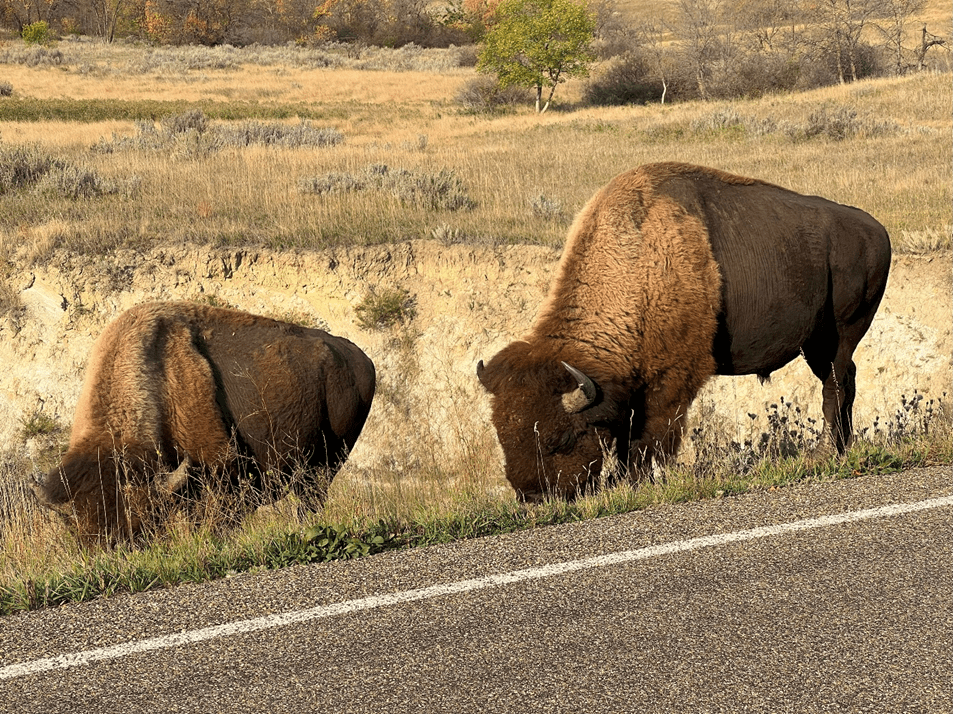

Sometimes they can block the path back to one’s vehicle:

The wildlife that provides the greatest amusement value are the prairie dogs:

There are hundreds of acres of “prairie dog towns” in the Southern Unit:
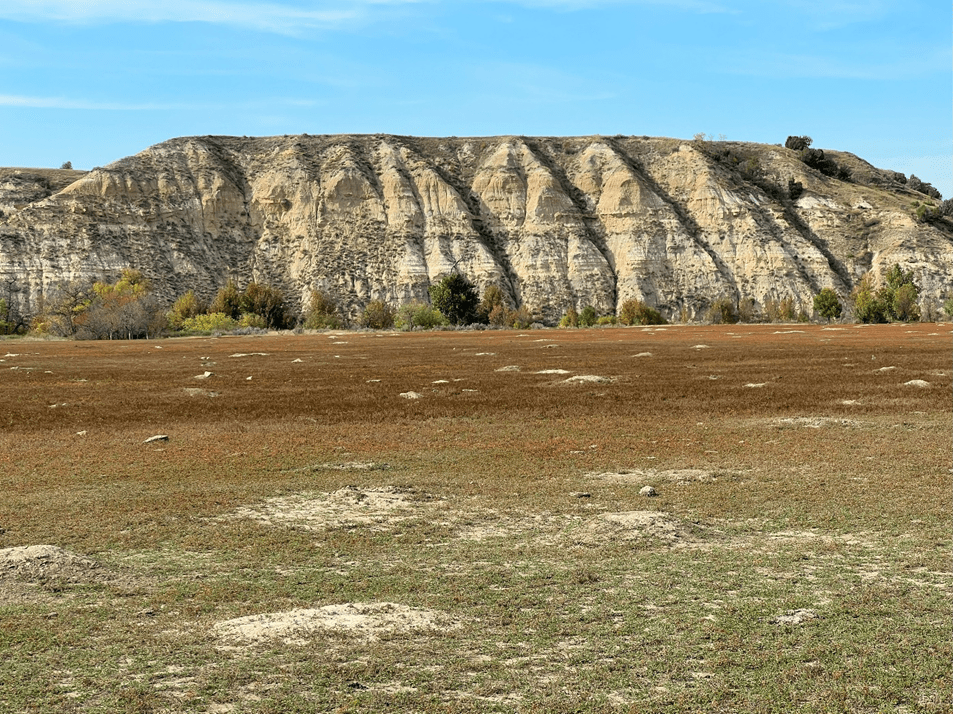
These dog towns can provide hours of amusement for children.
Returning from one of my hikes I encountered a horse blocking my path:
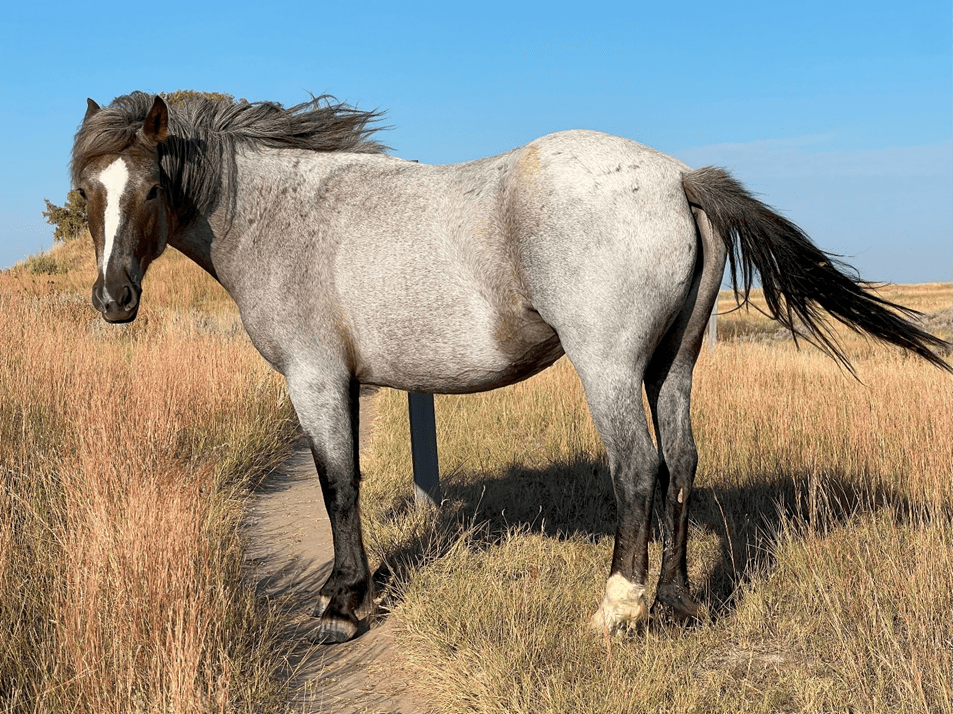
I assumed that this was a horse grazing from one of the local horse-riding ranches and confidently persuaded it to move.
Later, speaking to a fellow traveler, I was surprised to learn that this was actually a wild horse and there were more than 200 roaming the Park. I was puzzled because there was little discussion of this at any of the Visitor Centers. Apparently these are protected by the National Wild Free-Roaming and Burros Act of 1971, signed by President Nixon. Since the horses are not really part of the ecosystem in the Park and compete for grazing with other animals, it is likely that the National Park Service prefers that they not be there but are bound by the terms of the act. My fellow traveler informed me that the NPS had gone so far as to inoculate the herd and sterilize the females but was unable to remove them.


Time to leave the Park and head to Minnesota for a Rotary Training Session. The next National Park destination will be the Effigy Mounds National Monument.

 Journey Across America
Leave a comment