Crater Lake is actually a caldera lake. Crater lakes are formed when the top of a volcano is blown off in an eruption and the resulting space is filled with water from precipitation. In the case of a caldera lake, magma deep within the mountain is released creating a void into which the upper portion of the mountain collapses, forming a deep and wide hollow. Crater Lake resulted when the 12,000 ft Mount Mazama erupted some 7,700 years ago (an “eyeblink” in geologic history); the caldera walls are now around 6,500 ft high, and the maximum depth of the lake is nearly 2,000 ft (the deepest lake in the United States).
Crater Lake receives a lot of precipitation, more than 20 ft of snow in a typical year. It has no inlets or tributaries and the only outlet is through a layer of porous rock at the northern end. The Lake contains some 4.6 trillion gallons, which is considered to be the purest large body of water in the world (I have a one-liter bottle of this water, provided by a ranger straight from the lake—to be consumed at some appropriate future occasion).
The iconic view of the lake is from the southern rim with Wizard Island (a “small” volcano) prominently in the foreground:

It is simply breathtaking!
The water is an extraordinary hue of deepest blue resulting from the purity of the water and the depth of the lake:

Lake Tour
I took a tour of the lake in one of the boats pictured below:
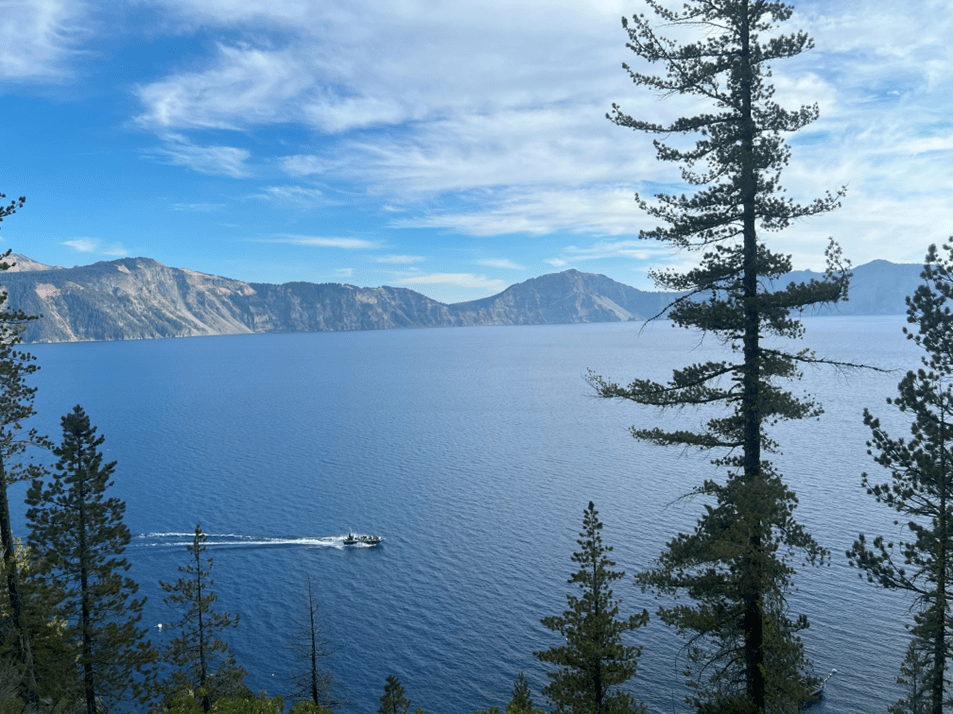
It was rather smaller than I expected. During the late afternoon, the wind was quite strong, churning up the surface of the lake; when the boat moved across the lake at high speed the effect was like being pounded from below by a jackhammer.
However, the views from the lake surface were well worth it. It was great to see the water up close with the caldera walls in the distance:

We made a close approach to Wizard Island, observing the multiple layers of both rock and vegetation (check out the white “toothpicks” of trees towards the top):

There were some cool “seeping waterfalls” emerging from the caldera walls:

At this point, the tour took on a mildly supernatural flavor (imposed by centuries of human observers). First, the “Devil’s Spine”—an unusual formation of harder volcanic rock:

Next the “Phantom Ship” which frequently sails in and out of the often-present fog.

Then the “Fairy Castle” perched prominently on the wall rocks:

Finally, a close encounter with the “The Old Man of the Lake,” a 30 ft-long tree stump floating vertically with the top 4 ft showing, that has been, moving vigorously across the lake, at least since 1896. The Old Man can travel quickly and unpredictably turn up anywhere. In early days, when private boats were permitted in the lake, the Old Man was thought to be a hazard to navigation and “his” position was carefully tracked.

In 1988, the lake was being explored by submarines and it was decided to minimize the movement of the Old Man by tying him up. The weather immediately went from clear to stormy and it started snowing—in August! Upon release of the Old Man, the weather promptly cleared up.


 Journey Across America
Leave a comment